The story of the Methodist church at Cairo from 1806 to today: the old river town, the circuit preachers, the Youree family, and the brick church Henry H. Youree's will paid for in 1916.
A 14-stop map of the church's story, from the 1790 fort near Cairo to Missouri, Texas and Louisiana and back.
More in this update (3)
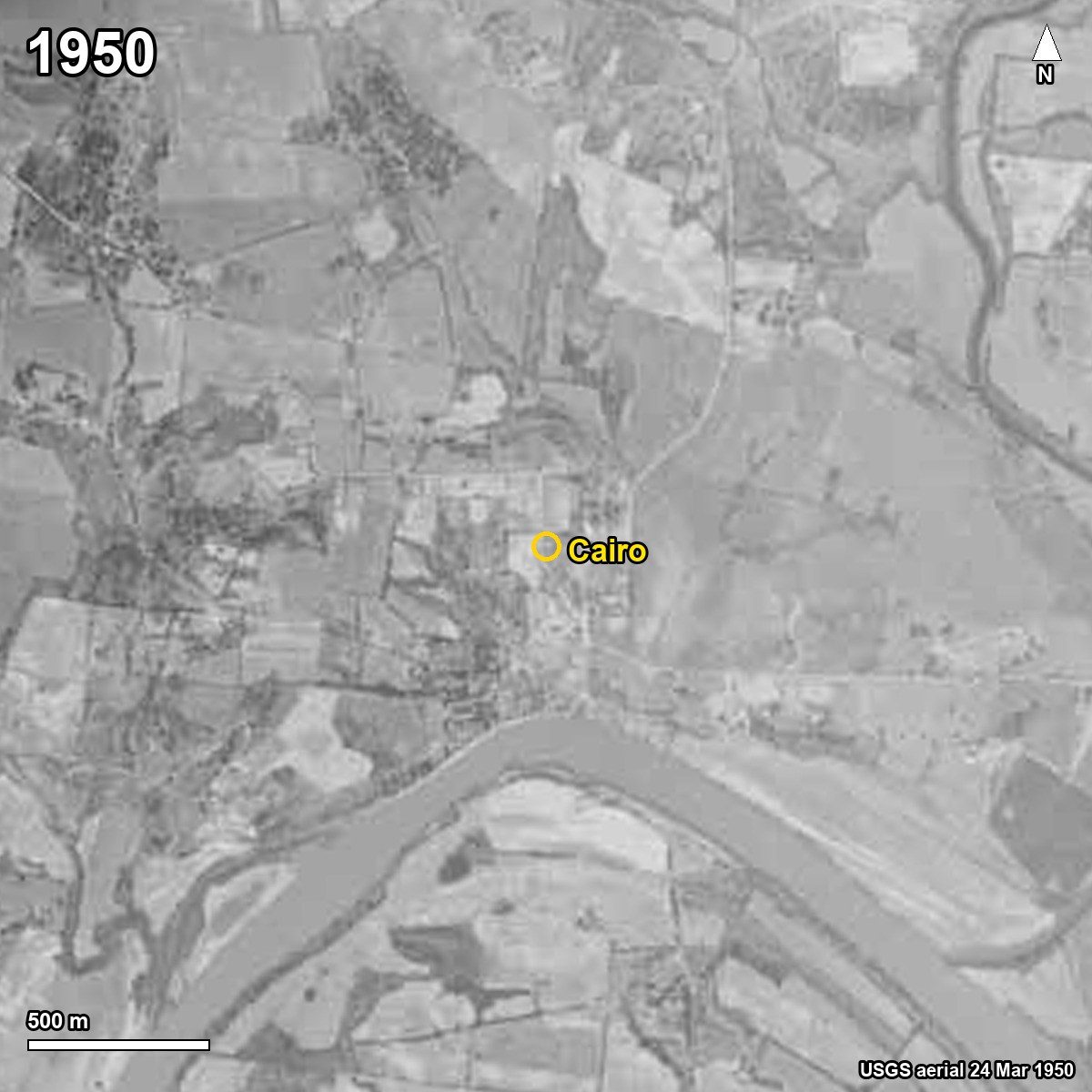
Two air-photo sliders: the village from 1950 to today, and the Cumberland River turning into Old Hickory Lake.
A family tree of the Yourees and the Barnes, Preuett, Bradley, Johnson and Newton families who kept the church, and the Black families of St. Mathews Chapel and the Rosenwald School next door.
Still unknown: a photo of the stone over the front door, the first church building, and the pastors from 1923 to 1988.
2395 Cairo Road, Gallatin, Tennessee
The Church on the Hill at Cairo
Methodists have met at Cairo, on the Cumberland River, since at least 1806. Their brick church was paid for by a son who grew up here, in memory of his mother and father.
Cairo United Methodist Church "on a hill overlooking the sleepy village of Cairo," March 1987. Photo by Billy Easley, The Tennessean, March 4, 1987, via Newspapers.com.
The story in brief
In October 1806 two Methodist preachers, Jacob Young and William McKendree, spent a Sunday preaching at "a town called Cairo, on the Cumberland River." It is the oldest record of Methodists here.
Cairo's streets were mapped out in 1799, and for two years it was the county's main town, where the county court met. By 1855 it was close to a ghost town. The church outlived it.
In 1910 Henry H. Youree, a Shreveport banker who had grown up on his parents' farm at Cairo, left $5,000 in his will for "a Church or School House" at Cairo in their memory. His brother Patrick, who still farmed at Cairo, chose a church over a school. It was dedicated in October 1916, and it is the church that stands today.
A small congregation still meets there every Sunday.
The church's story, place by place
Scroll to follow the story from the first fort near Cairo to the church today. Solid pins are exact places; dashed pins are close but approximate. Each stop is marked "proven by records" (a record says it), "likely" (a careful inference), or "family story" (local histories and memories).
1 of 14
1
Zeigler's Station
1790-1791
Who: The first settlers near Cairo Proven by records
Before there was a town, settlers clearing land along Bledsoe's Creek built a small fort, Zeigler's Station. In 1791 a war party of Creek, Cherokee and Chickamauga warriors attacked it. Between four and ten people were killed and more than a dozen carried off. General James Winchester led a band of local men after them, and the captives were later bought back and came home.
Old Cairo people said the fort "became a preaching place, and later a church was founded in Cairo." The fort stood about a mile and a half from Cairo.
Cairo and Gallatin in 1942, with the Cumberland River still in its old channel, twelve years before the dam. U.S. Geological Survey, Gallatin map, 1942.
2
The town of Cairo
1799 to about 1855
Who: General James Winchester and William Cage Jr. Proven by records
In 1799 James Winchester and William Cage Jr. bought 150 acres on the Cumberland River and laid out a town with four main streets. It was first named "Ca Ira," which local tradition says meant "it's alright," and the name wore down to Cairo. For its first few years the county's court met here. Then it moved to Gallatin, and Gallatin became the county's main town.
Between 1804 and 1830 Cairo had four doctors, two schools, thirteen stores, a cotton mill and a woolen mill, a boatyard, the Bell Tavern, a race track, two big warehouses at the river landing, and "a church." Barges, long wooden keelboats that men pushed upriver with poles, and steamboats tied up below the town. Then the courthouse went to Gallatin, river trade fell off and new roads passed it by. By 1855 Cairo was "virtually a ghost town."
Cairo in 1878. "M. E. Ch." (the Methodist Episcopal Church) stands on the west side of the road north of the crossroads, with "Col. Ch." (the Black congregation's church), the store, and the warehouse on the river. D. G. Beers & Co., Map of Sumner County, Tennessee, 1878, Library of Congress.
3
A Sunday at Cairo
October 1806
Who: Jacob Young and William McKendree Proven by records
In October 1806 Jacob Young, a young preacher who rode on horseback from church to church, was on his way to his new churches around Nashville, riding with William McKendree, the minister in charge of all the churches in the district (the "presiding elder"), who later became a bishop. They stopped at Cairo for the weekend. Young preached on Sunday morning and McKendree in the afternoon.
Methodists were preaching at Cairo by 1806, the earliest anyone knows of. ("Sabbath" means Sunday, "forenoon" means morning, and "took the parting hand" means they said goodbye.)
"On Saturday we came to the vicinity of a town called Cairo, on the Cumberland River ... We spent the Sabbath in this place. I tried to preach in the forenoon ... McKendree preached in the afternoon. Monday morning, amid much weeping, we took the parting hand."Jacob Young, remembering October 1806
A 1929 history of the Cairo church: "In the halcyon days of Cairo the Methodist congregation was composed of the Youree, Blakemore, Conn, Patterson, Newton, Hamilton, Bruce, Green and other families." Mrs. Bennett D. Bell, Sumner County News, Gallatin, 1929, FamilySearch.
4
Gallatin and Cairo
1828 to 1838
Who: The circuit preachers Proven by records
In those days a Methodist preacher rode a circuit: a string of country churches he visited in turn. Each year the Methodist leaders for Tennessee (the Tennessee Conference) decided which preacher went where. From 1828 Cairo was named in that yearly list, sharing a preacher with Gallatin ("Gallatin and Cairo") or with Lebanon ("Lebanon and Cairo"). The first was Fountain E. Pitts, a famous speaker, and many more followed him.
5
Lafayette County, Missouri
about 1840 to 1862
Who: Patrick and Malvina Youree and their children Proven by records
Patrick Espy Youree, born in Tennessee in 1812, married Malvina Zimmerman of Kentucky in 1833. By 1840 they were farming in Lafayette County, Missouri, near Waverly. By 1850 the house was full: six children, from Francis, 16, down to little Patrick, 3, plus Patrick's brother William and his family. Henry, the youngest, was born in 1856.
Peter rode with the Confederate cavalry. When the Union army took over Missouri in the Civil War, the parents took the younger children east to a family farm on the Cumberland at Cairo.
6
The Youree farm at Cairo
about 1862 to 1923
Who: Patrick and Malvina Youree; their sons Patrick Jr., Isaac and Henry Proven by records
The farm was "a quiet little home they had inherited, situated on the Cumberland River, just between Nashville and Gallatin." Patrick's father was probably Francis Yourie, who came from Ireland and died in 1861. By 1870 Patrick, 58, was farming land worth $7,000, with Malvina and their sons Patrick, Isaac and Henry, who was 13 and in school.
By 1878 their farm sat just northeast of Cairo village, with more Youree farms nearby. Malvina died in 1883 and Patrick in 1885; they are buried together in Gallatin. Their son Patrick stayed on at Cairo all his life.
The country around Cairo in 1878: "P. E. Youree" just northeast of the village, more Youree farms to the north and west, and the Barnes, Haynes, Robb and Newton places. D. G. Beers & Co., Map of Sumner County, Tennessee, 1878, Library of Congress.The 1870 census in Sumner County: Patrick Youree, 58, farmer; Malvina, 54; sons Patrick, 22, Isaac, 20, and Henry, 13, "at school." 1870 U.S. census, Sumner County, Tennessee, FamilySearch.The 1880 census in the Second District (Cairo): Patrick, 68, farming; Malvina, 64; and their son Pat, 32. 1880 U.S. census, Sumner County, Tennessee, FamilySearch.
7
Scottsville, Texas
about 1876 to 1898
Who: Henry and Peter Youree Likely
At nineteen Henry left Cairo for East Texas to work in his brother Peter's store at Scottsville. Peter had married Bettie Scott of Scottsville. With W. T. Scott Jr., Henry went into building railroads and streetcar lines across Texas. In 1887 he married Mary Rose Austin of Marshall. They had no children. Both brothers are buried in the family lot at Scottsville.
Capt. Peter Youree (1843-1914), Henry's older brother, a banker, who helped carry out Henry's will. Portrait as printed in an early 1900s publication, via Find a Grave (memorial 5564998).Peter Youree's gravestone at Scottsville, Texas. It calls him a captain in General Shelby's Missouri cavalry, on the Confederate side. Find a Grave (memorial 5564998).
8
St. Mathews Chapel
1881 to 1907 and after
Who: The Black Methodist congregation of Cairo Proven by records
Cairo's Black Methodists had their own church by 1878, when the county map marked it "Col. Ch." ("Colored Church," the word used then). In August 1881 a Mr. Parkerson deeded a lot in town to the church's trustees, Thomas Davis and others. (Trustees are members chosen to look after a church's land and money.) It was St. Mathews Chapel, of the Colored Methodist Episcopal Church, the Black Methodist church formed after the Civil War.
By 1907 the old meeting house was unsafe. The members voted to tear it down and build a new one. They bought the lumber themselves and borrowed money from the bank for the shingles, flooring and carpenters, promising their church land if they couldn't pay it back. Two leaders of the white Methodist church, C. H. Newton and T. W. Barnes, put their own names on the loan too. The new church went up about 1908. People at Cairo remembered Jeff Scott as its first pastor.
July 1907: Howard Mills, Gaston Harrison (the name is hard to read) and Wm Robb, trustees of "St. Mathews Chapel Colored Methodist Episcopal Church in America, situated at Cairo," pledge the church lot for a building loan. C. H. Newton and T. W. Barnes signed for the loan with them. Sumner County deed records, 1907, p. 263, FamilySearch.
9
Shreveport, Louisiana
1898 to 1910
Who: Henry Hudson Youree Proven by records
In 1898 Henry joined Peter in Shreveport, where Peter was president of the Commercial National Bank. Henry was its vice president for ten years. He was quiet and generous; he gave the Shreveport Home for the Homeless its first big gift, and his whole life he sent his mother money so she would have "her own little bank account with no strings tied to it."
He made his will on April 23, 1910, and died on May 12 after a long illness, in his brother Peter's arms. Besides $5,000 for a home for old men in Shreveport, he left $5,000 for "a Church or School House" at Cairo "in memory of my father and mother."
"It is my desire and I hereby direct that my Executors have erected at or near Cairo, Sumner County, Tennessee either a Church or School House ... said building to be erected in memory of my father and mother and to cost not less than Five Thousand Dollars."Will of Henry H. Youree, April 23, 1910
Henry H. Youree's will, April 23, 1910. Item Fifth: "my Executors have erected at or near Cairo, Sumner County, Tennessee either a Church or School House ... in memory of my father and mother and to cost not less than Five Thousand Dollars." Will of H. H. Youree, Caddo Parish, Louisiana, as recorded in Sumner County, Tennessee; FamilySearch.May 26, 1910: "$5,000 in the erection of a school, or church ... at Cairo, Tenn., in memory of the father and mother of deceased." The Shreveport Journal, May 26, 1910, p. 2, via Newspapers.com."During the war when the Federals had overrun Missouri, his father, P. E. Youree, his mother, Malvina M. Youree, and the younger children went to a quiet little home they had inherited, situated on the Cumberland River, just between Nashville and Gallatin. There Henry received his early training and education." The Shreveport Times, May 29, 1910, p. 24, via Newspapers.com.May 14, 1910: a special train of three coaches took Henry Youree's family and friends to Scottsville, Texas, for his burial. The Shreveport Journal, May 14, 1910, p. 4, via Newspapers.com.
10
The new church
1916
Who: Patrick E. Youree Jr. and the trustees Proven by records
Henry's brother Patrick, still farming at Cairo, decided the money should build a church, and he oversaw the work. The new brick church went up on the hill above the village in 1916. It was dedicated on a Sunday in early October 1916.
So many people came that the building could not hold them. Rev. J. R. Stewart of Nashville preached the sermon, Rev. W. L. Jackson, the minister over the district's churches, led the morning, and the church was handed over to its trustees: P. E. Youree, T. W. Barnes, C. B. Pruitt, Dock Bandy and W. G. Schamberger. Dinner was served on the grounds, and in the afternoon visitors from other churches spoke.
October 12, 1916: "Large Crowd Gathers Cairo Sunday For All-Day Service" for the dedication of the new church. Sumner County News, Gallatin, October 12, 1916, p. 1, FamilySearch."The church, which is a handsome brick structure, was built by a bequest of the late Mr. Henry H. Youree of Shreveport, Louisiana ... Mr. P. E. Youree of Cairo, a brother of the deceased, decided that the fund should be used in the erection of a church and has directed its construction." Sumner County News, Gallatin, October 12, 1916, FamilySearch."Tribute to parents remains": the 1987 newspaper photo and its caption, which quotes the stone over the front door. The Tennessean, March 4, 1987, p. 40, via Newspapers.com.
11
Gallatin City Cemetery
1883, 1885 and 1923
Who: Malvina, Patrick and Patrick Jr. Youree Proven by records
The parents the church honors are buried under one monument in the Gallatin City Cemetery: Malvina, who died on May 28, 1883, and Patrick, who died on April 19, 1885. Their son Patrick Jr., who never married and lived 29 years with the Prewett family at Cairo, died on February 15, 1923. His funeral was preached in the church his brother paid for, and he was buried beside his parents.
The Youree monument in the Gallatin City Cemetery: "Patrick Espy Youree, born Feb. 16, 1812, died April 19, 1885. Malvina Marguerite Youree, born Feb. 12, 1817, died May 28, 1883." Photo by BBrown, 2014, Find a Grave (memorial 99038586).Another face of the same monument: "Patrick Espy Youree Jr., born Dec. 17, 1847, died Feb. 15, 1923." Photo by BBrown, 2014, Find a Grave (memorial 99038638).February 1923: Patrick E. Youree Jr. dies at Cairo. "One of his brothers, Henry, left a sum of money to build a church at Cairo, and the funeral will be preached in this church." Nashville Banner, February 16, 1923, p. 2, via Newspapers.com.
12
The Cairo Rosenwald School
1923 to 1959
Who: The Black families of Cairo Proven by records
Right beside the church lot stands the Cairo Rosenwald School, one of the schools for Black children built across the South with help from a fund set up by Julius Rosenwald, president of Sears, Roebuck. Cairo's Black families raised $700 for it, the state school fund put in $700 and the Rosenwald Fund $500. It opened in 1923 and taught grades one through eight until May 1959. J. Hutch Brinkley was its principal from 1944 until it closed.
The building became the community's meeting place. In 1996 the Cairo Improvement Club got it put on the National Register of Historic Places, the country's official list of places worth saving.
The Cairo Rosenwald School, built 1922-23, next to the church lot. Photo by "rossograph," 2021, Wikimedia Commons, CC BY-SA 4.0.The school in April 1996, when it was put on the National Register of Historic Places. Photo by Elizabeth A. Straw, 1996, National Register of Historic Places file, National Park Service.The state historical marker for the Cairo Rosenwald School. Photo by Brian Stansberry, 2008, Wikimedia Commons, CC BY 3.0.
13
The lake
1954
Who: Old Hickory Dam Proven by records
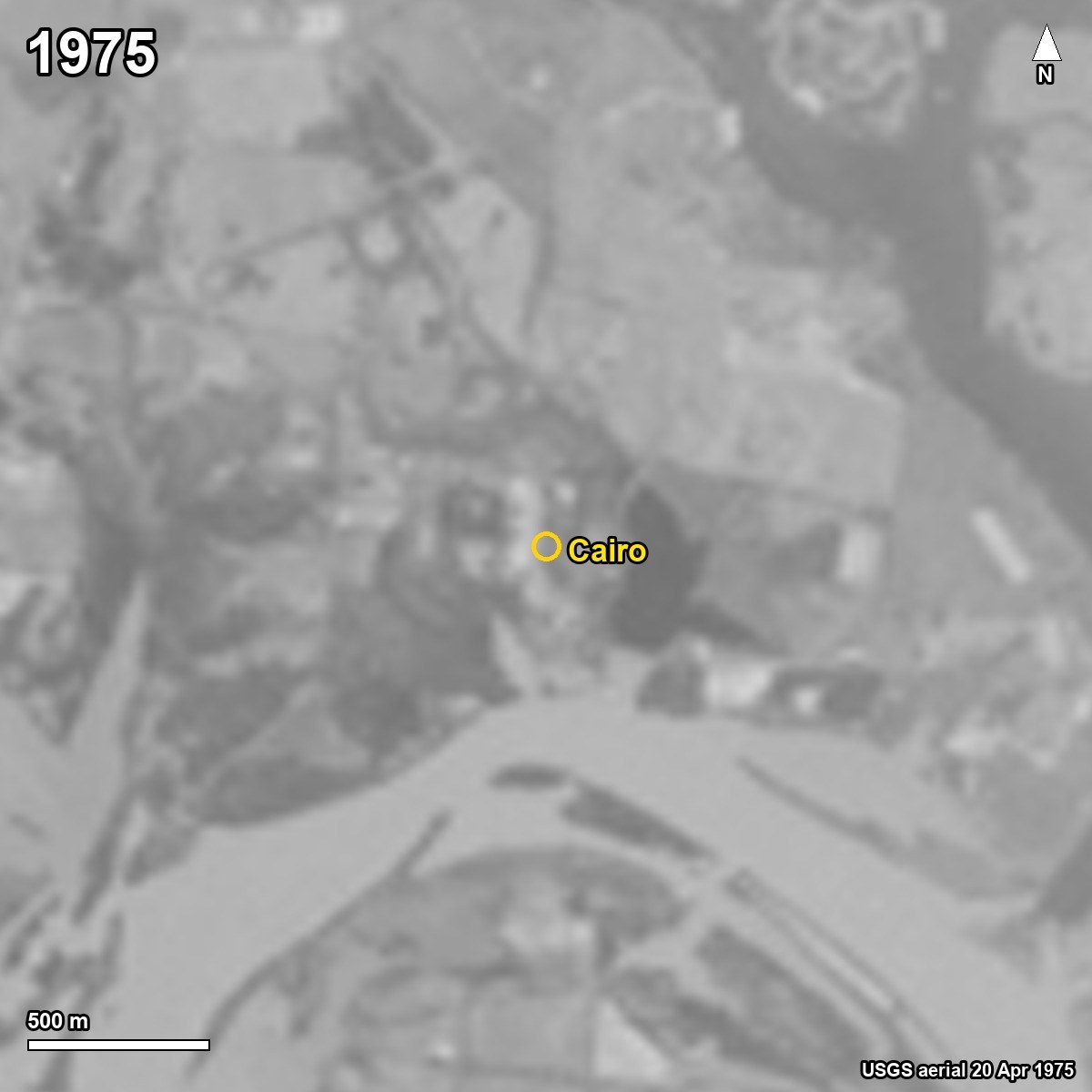
In 1954 workers finished Old Hickory Dam, about 17 miles downriver, and the river backed up into Old Hickory Lake. The old Cairo landing and ferry, where the steamboats once tied up, went under the water. A cove of the lake now reaches to within about 150 yards of the church. Dovie Barnes, a church member who wrote down Cairo's history, said in 1956 that "Cairo is expected to rise again." The village became a lake neighborhood, and the end of Cairo Road became a boat ramp.
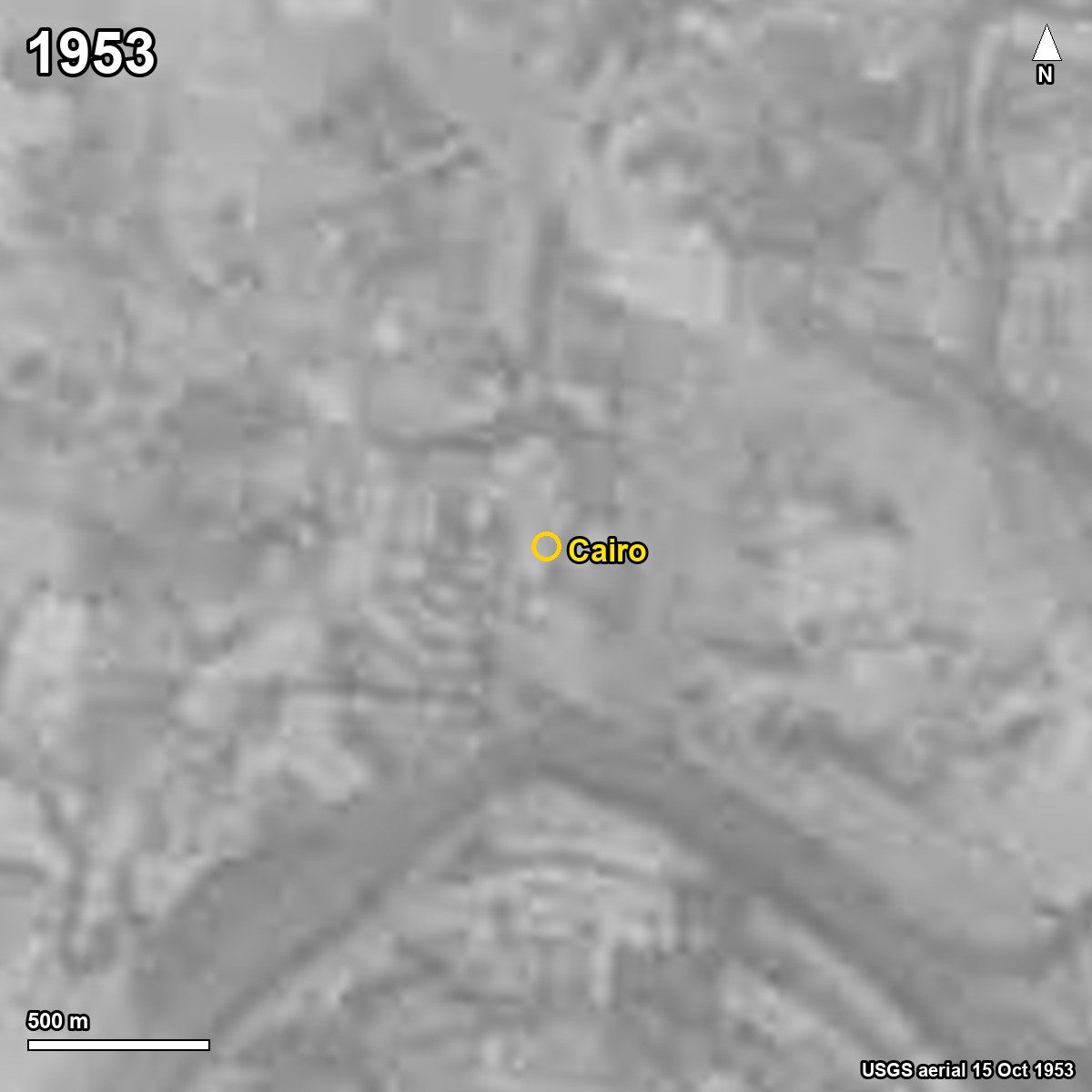
October 1953: still the river, a few months before Old Hickory Dam closed. U.S. Geological Survey air photo, October 15, 1953.1975: the river bottom under Old Hickory Lake. A cove of the lake now reaches to within about 150 yards of the church. U.S. Geological Survey air photo, April 20, 1975.
14
Cairo United Methodist Church today
1968 to today
Who: The congregation Proven by records
In 1968 the Methodists joined with another church to form the United Methodist Church, and it became Cairo United Methodist Church. In 2025 it had 27 members, and about a dozen people still come every Sunday. On October 30, 2016, the congregation held a homecoming for the building's 100th birthday.
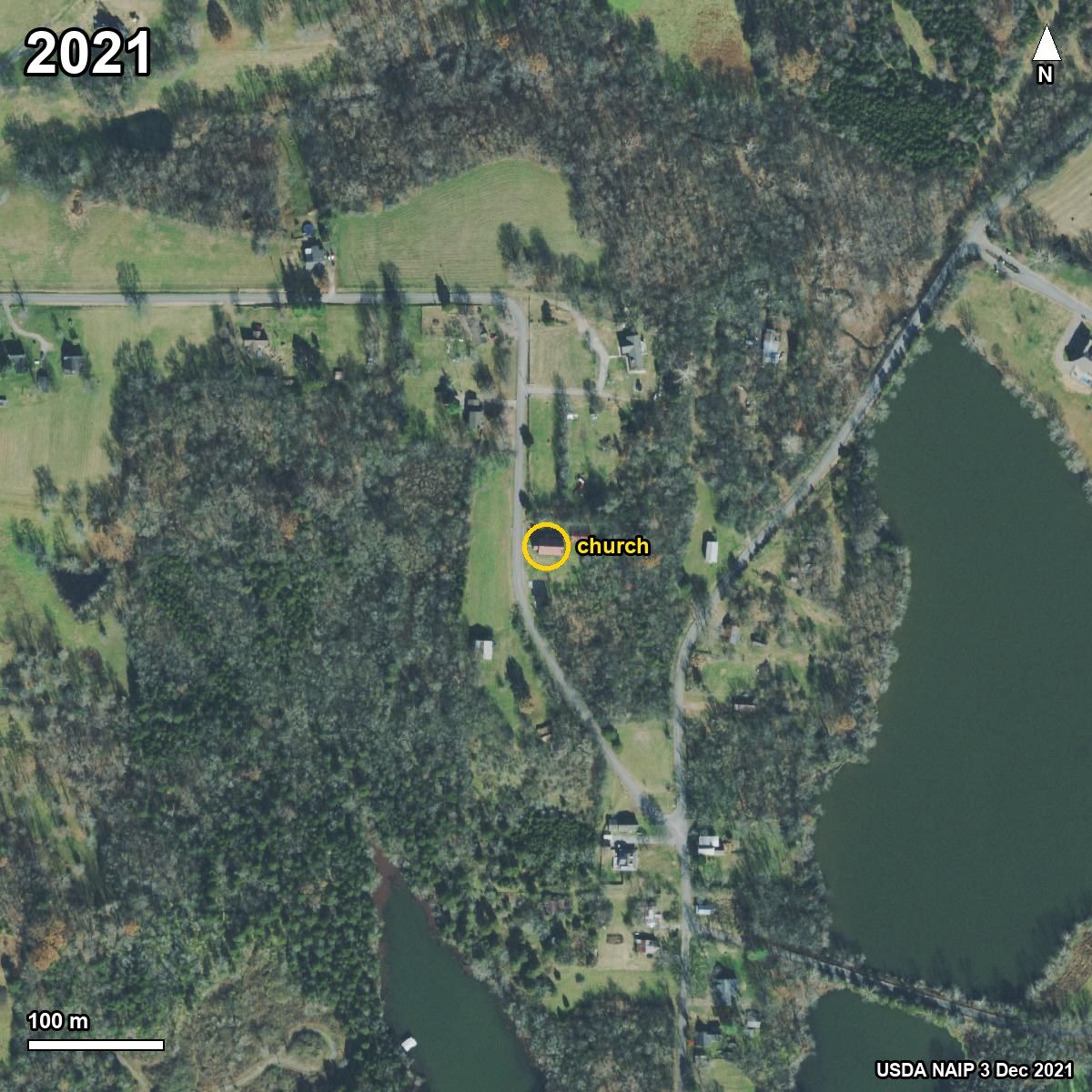
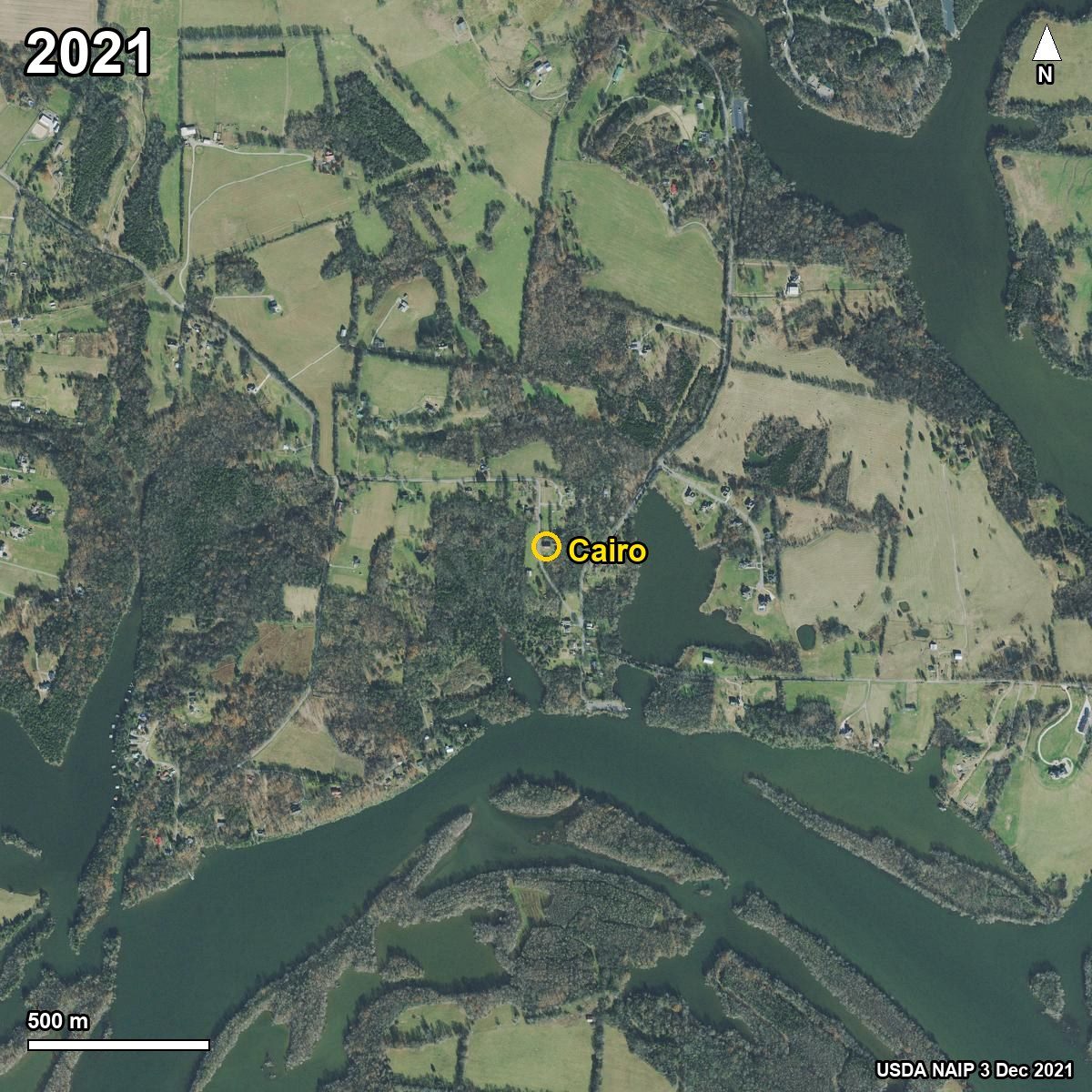
"Cairo United Methodist Church, founded in 1806, meets in this building which was completed in 1916," 1991. Photo by Billy Easley, The Tennessean, February 6, 1991, via Newspapers.com.2021: lake houses fill in around the old village. U.S. Department of Agriculture air photo, 2021.
The families of the Cairo church
Everyone in the church's story: the Youree family who built it, the families who kept it, and their neighbors at St. Mathews Chapel and the Rosenwald School. Tap anyone to move the tree to them. A solid outline means proven by records, a dashed outline means likely, and a dotted outline means a family story or not yet proven. A grey box means living. A 'Not yet known' box is a parent whose name isn't known.
Proven by recordsLikelyFamily story, or not yet provenLiving
Swipe the tree sideways to see more of the family.
The church on the hill
The brick church Henry Youree's will paid for, and what the records say about it.
The church stands on a ridge above the old village, facing Cairo Road. It is brick on a stone base. The front wall rises above the roof line, with brick buttresses at the corners, wide eaves on wooden brackets, and double wooden front doors under a single-pane window. The style is called "Spanish Mission," and you hardly ever see it on a Tennessee country church. It seats 150 and has two Sunday school rooms.
Built
1916; dedicated in early October 1916
Paid for by
the will of Henry H. Youree of Shreveport (died 1910): at least $5,000
Built under
his brother Patrick E. Youree Jr. of Cairo
In memory of
their parents, Patrick E. Youree (1812-1885) and Malvina Youree (1817-1883)
First trustees
P. E. Youree, T. W. Barnes, C. B. Pruitt, Dock Bandy, W. G. Schamberger
Seats
150, with two Sunday school rooms (1956)
Lot
3.6 acres on Cairo Road
Cairo United Methodist Church "on a hill overlooking the sleepy village of Cairo," March 1987. Photo by Billy Easley, The Tennessean, March 4, 1987, via Newspapers.com.
The dedication
On a Sunday in early October 1916 "a large crowd gathered at Cairo" for the dedication of the "handsome brick structure." Not even half the crowd could get inside. Dinner was served on the grounds.
October 12, 1916: "Large Crowd Gathers Cairo Sunday For All-Day Service" for the dedication of the new church. Sumner County News, Gallatin, October 12, 1916, p. 1, FamilySearch."The church, which is a handsome brick structure, was built by a bequest of the late Mr. Henry H. Youree of Shreveport, Louisiana ... Mr. P. E. Youree of Cairo, a brother of the deceased, decided that the fund should be used in the erection of a church and has directed its construction." Sumner County News, Gallatin, October 12, 1916, FamilySearch.Dovie Barnes's 1956 "History of Cairo": "This church has a seating capacity of one hundred and fifty and two Sunday school rooms." Dovie Barnes, Gallatin newspaper, spring 1956, FamilySearch.
The stone over the door
A stone above the front door reads, as a 1987 newspaper printed it: "Built in memory of my parents Patrick E. Jr. and Malvina Youree by H.H. Youree in 1916."
The "Jr." doesn't fit. Henry's parents were Patrick Espy Youree (1812-1885) and Malvina. Patrick E. Youree Jr. (1847-1923) was Henry's brother, the one who built the church. The 2016 centennial article says the church honors "Patrick E. Sr. and Malvina M. Youree." Either the 1987 newspaper copied the stone wrong, or the stonecutter slipped. A clear photo of the stone would settle it.
"Tribute to parents remains": the 1987 newspaper photo and its caption, which quotes the stone over the front door. The Tennessean, March 4, 1987, p. 40, via Newspapers.com."Cairo United Methodist Church, founded in 1806, meets in this building which was completed in 1916," 1991. Photo by Billy Easley, The Tennessean, February 6, 1991, via Newspapers.com.
The church lot
Nobody knows who first gave the church its land. By 1953 the church had used it for more than 40 years, and that year its trustees, Tom Bradley, Roy Brown and Earl Fitzpatrick, and the neighbors agreed where the lines were. The neighbors were the county school board (the Rosenwald School grounds), Lynn Anglea, and Mary E. and Leslie Hamilton. The 3.6 acres still belong to "Church Cairo Methodist."
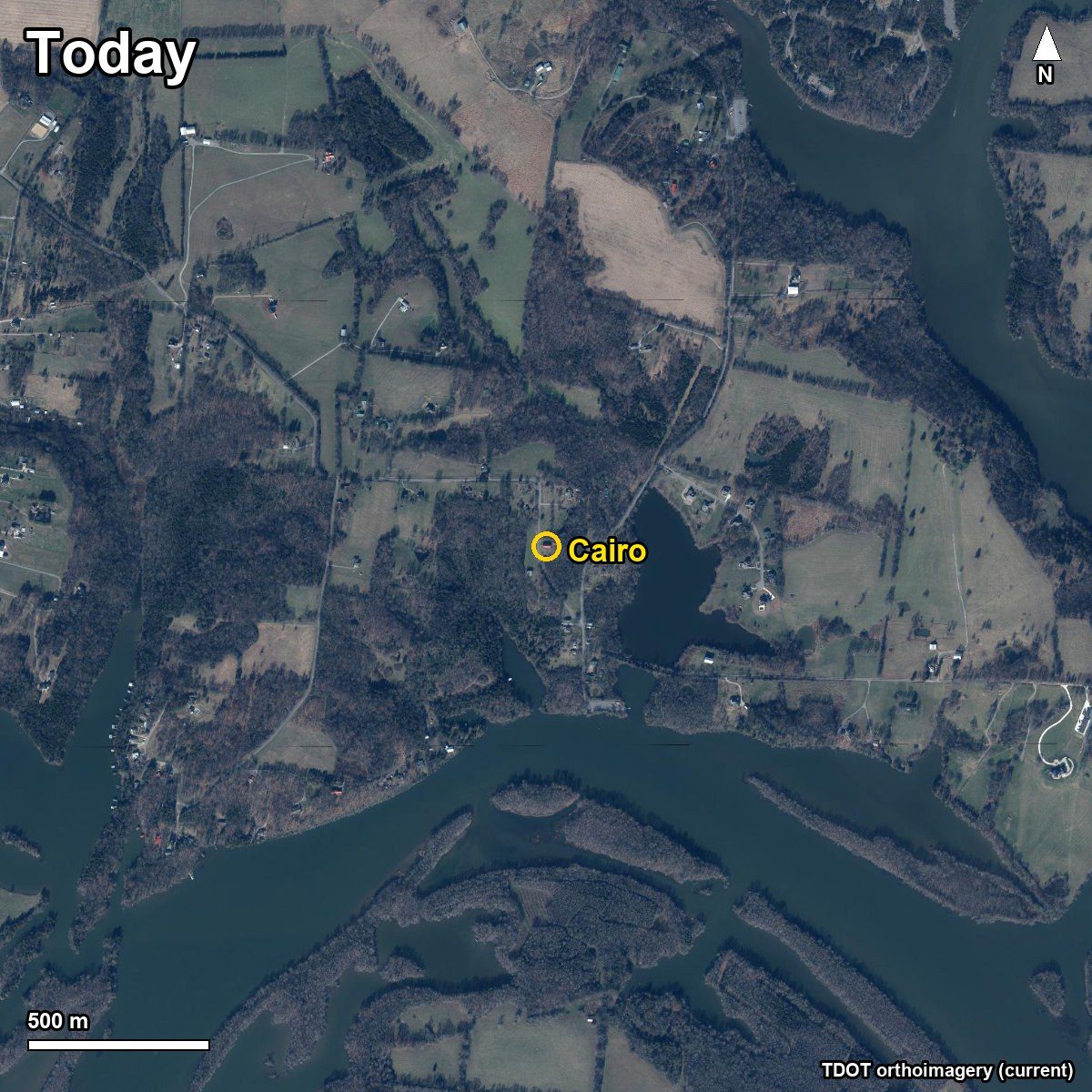
April 16, 1953: trustees Tom Bradley, Roy Brown and Earl Fitzpatrick of "the Methodist Church of Cairo" settle the line of the church lot with the neighbors. Sumner County deed records, 1953, FamilySearch.The church lot today (3.6 acres), with the county's lot lines. Tennessee property maps over Tennessee Department of Transportation imagery.
Where the stories differ
Who gave the money. Some old Cairo histories say Peter Youree or "Patrick Youree of Shreveport" gave it. It was Henry: his will and his brother Patrick's obituary both say so.
Who chose a church. The will let Henry's widow Mary Rose and his brother Peter choose "a Church or School House." Peter died in 1914, and it was Patrick, at Cairo, who decided on a church and ran the building of it.
Henry's birthday. August 2, 1856, his gravestone says; a relative remembered the year as 1857.
Two hundred years of Methodists at Cairo
Circuit riders, a country church, an endowment, revivals and homecomings.
1806October: Jacob Young and William McKendree preach at Cairo on a Sunday, the oldest record of Methodists here.
About 1830Cairo has a school and a church for its thirty families.
1828-1838"Gallatin and Cairo" (sometimes "Lebanon and Cairo") is a named preaching assignment of the Tennessee Conference.
1844Methodists split into a Northern church and a Southern church over slavery. Cairo's church goes with the Southern one.
1876Cairo shares a preacher, J. G. Ray, with Bethpage.
1878The county map marks the "M. E. Ch." in the village, and a "Col. Ch." for the Black congregation.
1888Cairo has its own circuit for a while, with R. M. Chennault as preacher. After that its preacher usually lives at Castalian Springs and comes over to preach.
1910Henry H. Youree's will leaves $5,000 for a church or school at Cairo.
1916The new brick church is dedicated in October.
1923Miss Sallie E. Bruce's gift of $7,277.93 helps pay the church's preacher for years to come.
1939The northern and southern Methodist churches reunite; it becomes "Cairo Methodist Church."
1953The trustees settle the boundary of the church lot.
1954Old Hickory Dam is finished, and the river below Cairo becomes a lake.
1968It becomes Cairo United Methodist Church.
2016October 30: a homecoming for the building's 100th year.
Circuit riders
For most of its life Cairo did not have a preacher of its own. A preacher rode a circuit, a string of country churches, and Cairo got preaching on its Sunday in the rotation. From 1828 to 1838 the Tennessee Conference listed Cairo by name beside Gallatin or Lebanon. In 1876 it was "Bethpage and Cairo," and in 1888 there was briefly a "Cairo Circuit." Into the 1950s the church was served from Castalian Springs, the Sumner Circuit or the Gallatin circuit, and the business meeting of all the circuit's churches, held four times a year, sometimes met at Cairo.
Some of Cairo's pastors were Rev. Mr. Haynes (1917), E. B. Troutt (1932), R. M. Johnson (1940), J. Marvin Sweat (about 1950) and Ron Wright (2022).
The endowment
Miss Sallie E. Bruce left half of what she owned to "the Methodist Episcopal church at my old home Cairo." The church was to lend the money out, and the interest it earned each year would help pay the preacher. On January 5, 1923, the trustees signed for $7,277.93. No other church in the county had a gift like it; a 1931 writer called Cairo "the only endowed church in Sumner county."
January 5, 1923: trustees T. W. Barnes, C. B. Pruett, W. G. Schamberger, P. E. Youree and C. H. Newton receive $7,277.93 left to the church by Miss Sallie E. Bruce. Sumner County court records, January 1923, FamilySearch.
Church life
From the 1920s to the 1950s the church was the center of a small community. Mrs. B. O. Donoho went from "the Cairo church" to the Woman's Missionary Society conference in 1921. There was a Children's Day program every May, a revival every July, and a gospel quartet, the Crusaders, in March 1956. In 1946 the farmers came to the church to vote on how much tobacco they would be allowed to grow. The Cairo Community Improvement Club met in the church, and the old families held their funerals there before burial in the family graveyards around Cairo.
A 1929 history of the Cairo church: "In the halcyon days of Cairo the Methodist congregation was composed of the Youree, Blakemore, Conn, Patterson, Newton, Hamilton, Bruce, Green and other families." Mrs. Bennett D. Bell, Sumner County News, Gallatin, 1929, FamilySearch."A humble Tennessee town that had great beginnings," 1991: "The Methodist Church dates to 1806 and still meets regularly in a house of worship completed in 1916." M. J. Caldwell, The Tennessean, February 6, 1991, p. 51, via Newspapers.com.
Members
1989: 39 members; about 21 in church on a Sunday
2001: 43 members
2010: 35 members; about 17 on a Sunday
2020: 25 members; about 14 on a Sunday
2025: 27 members; about 13 on a Sunday
The village and the river
Cairo from the air, from the old river to the lake.
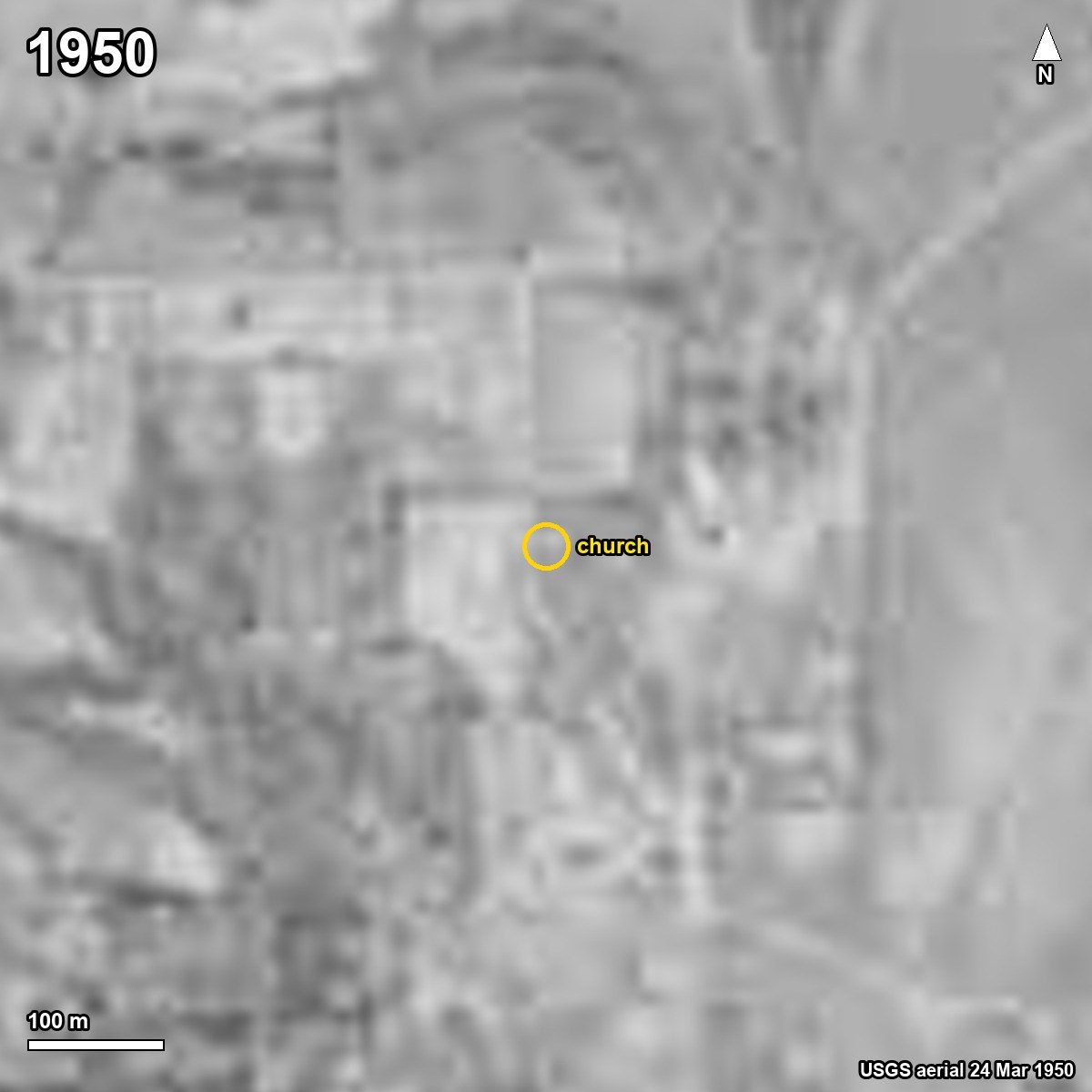
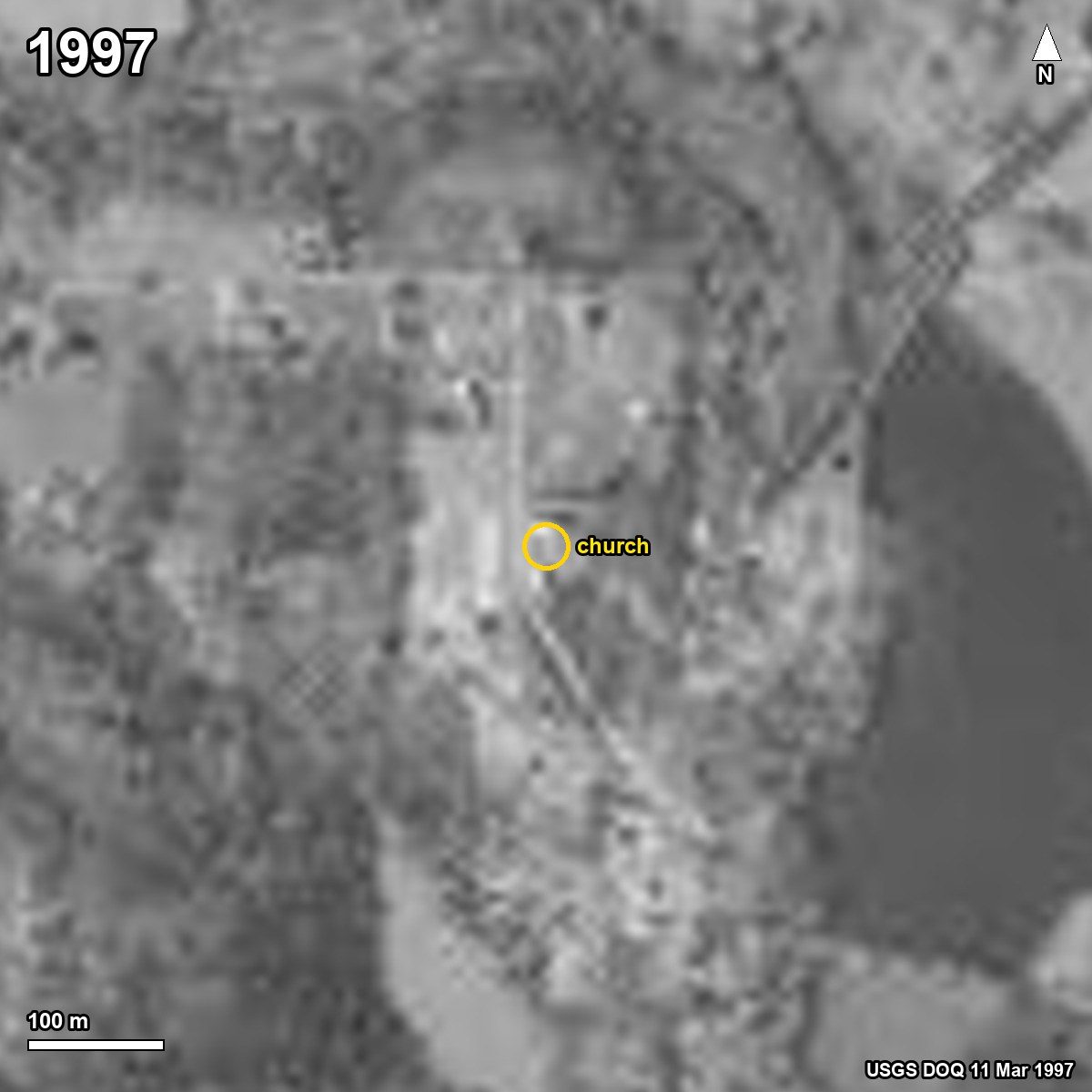
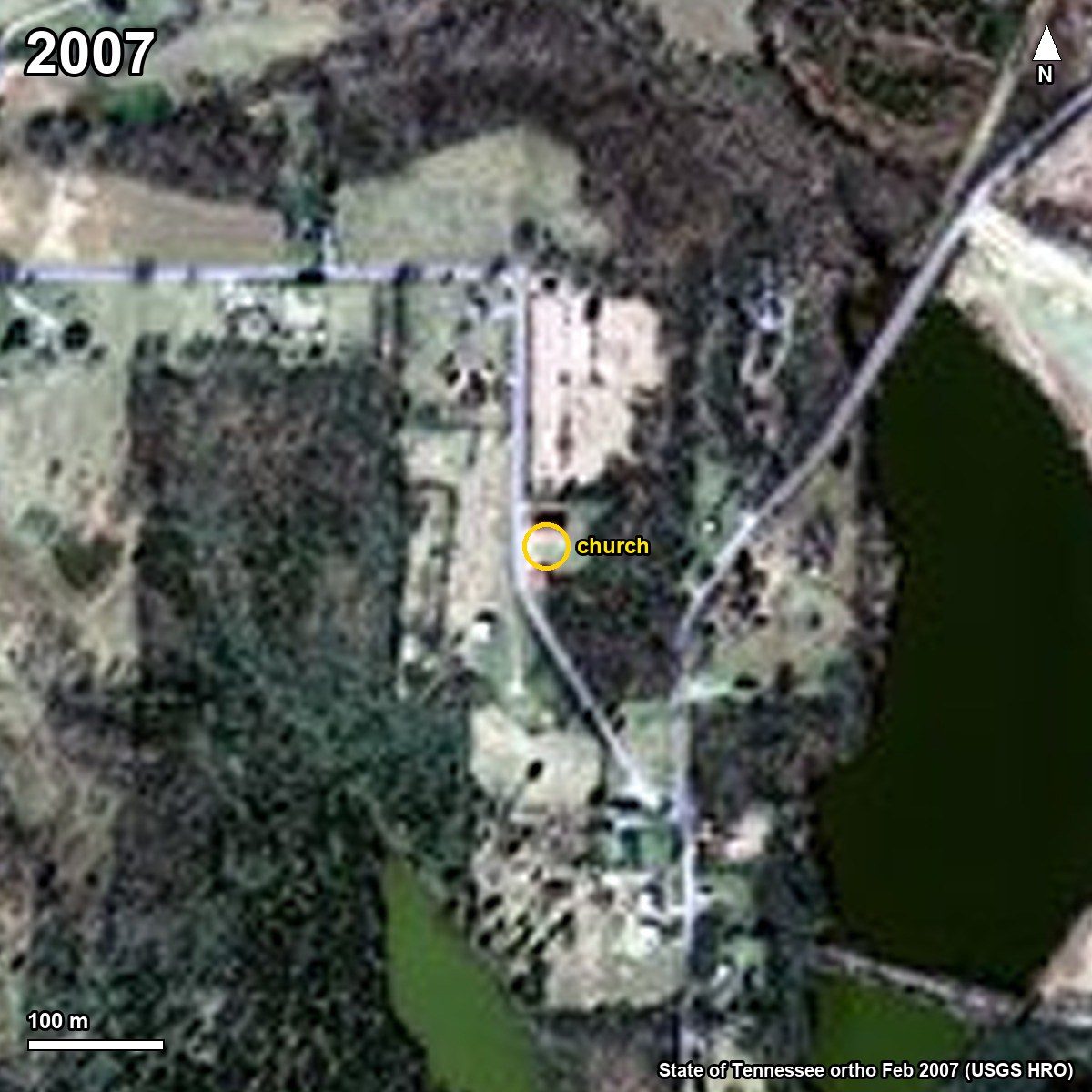
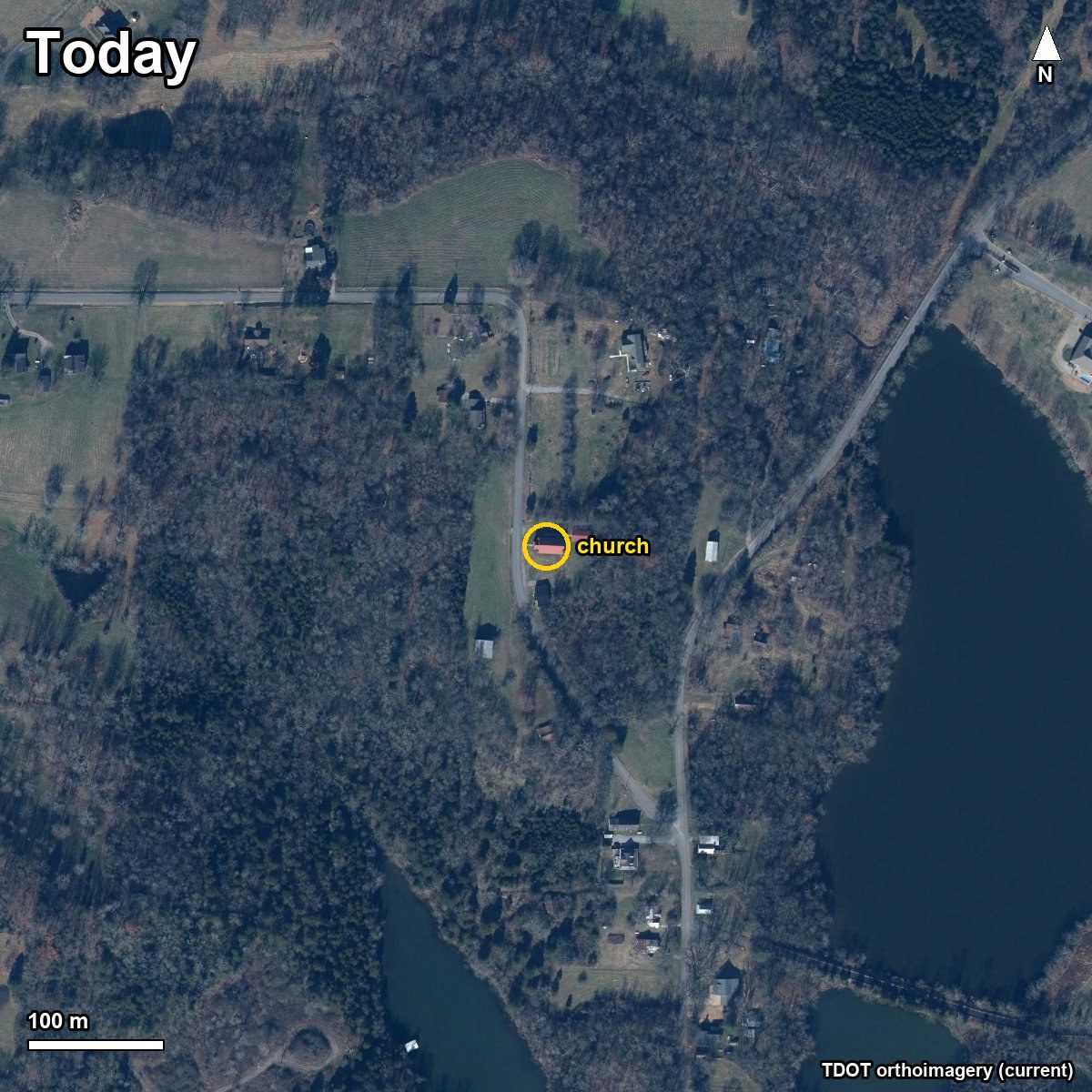
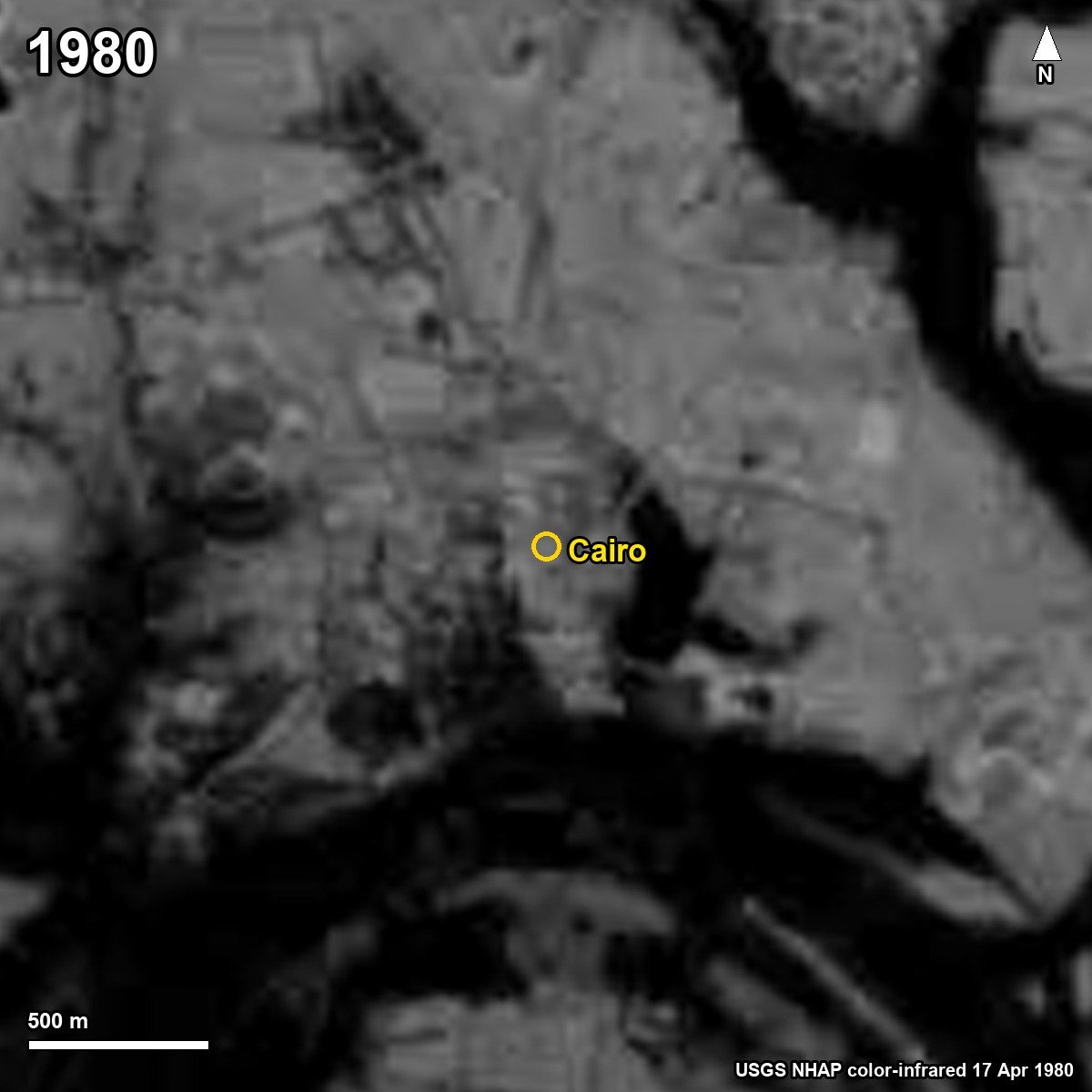
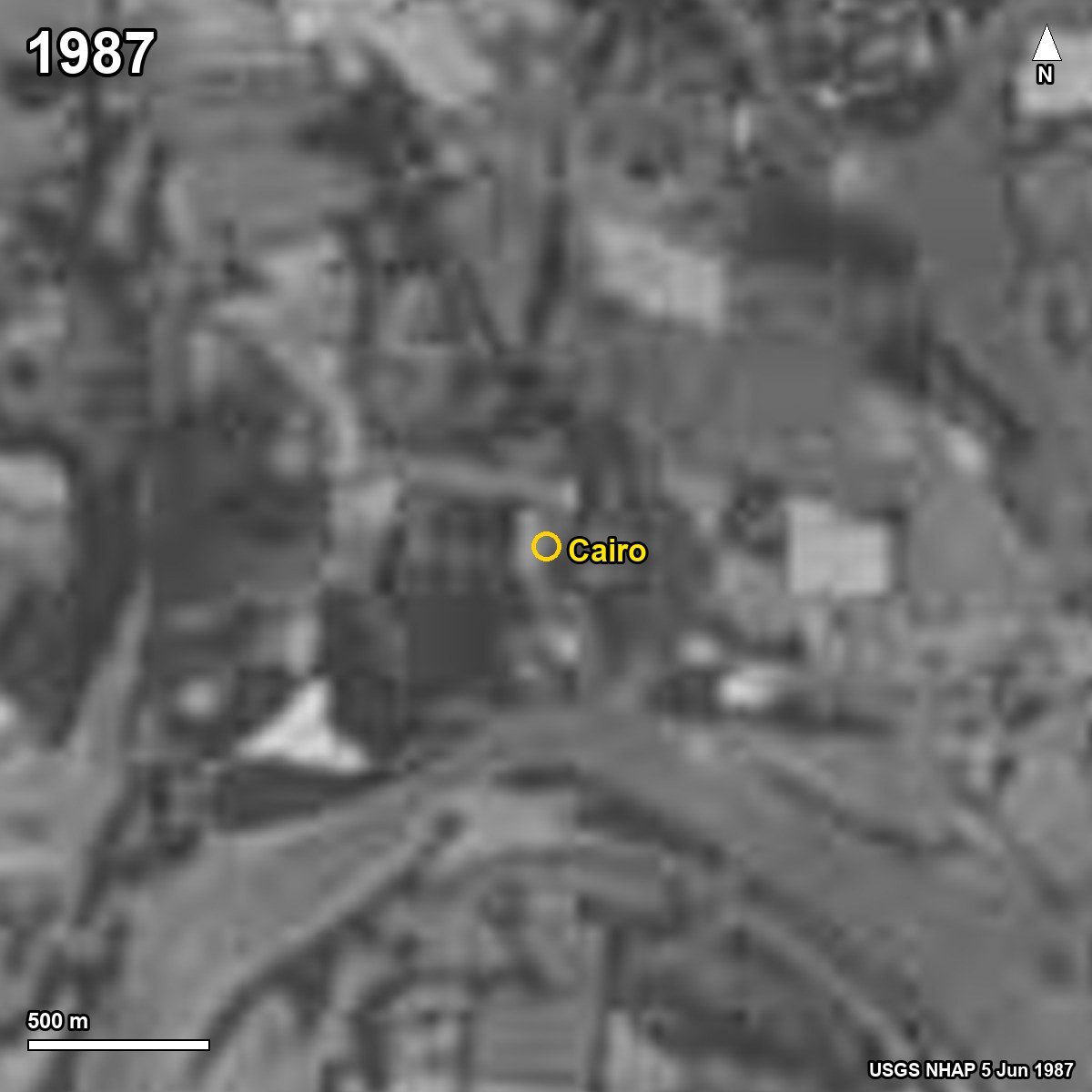
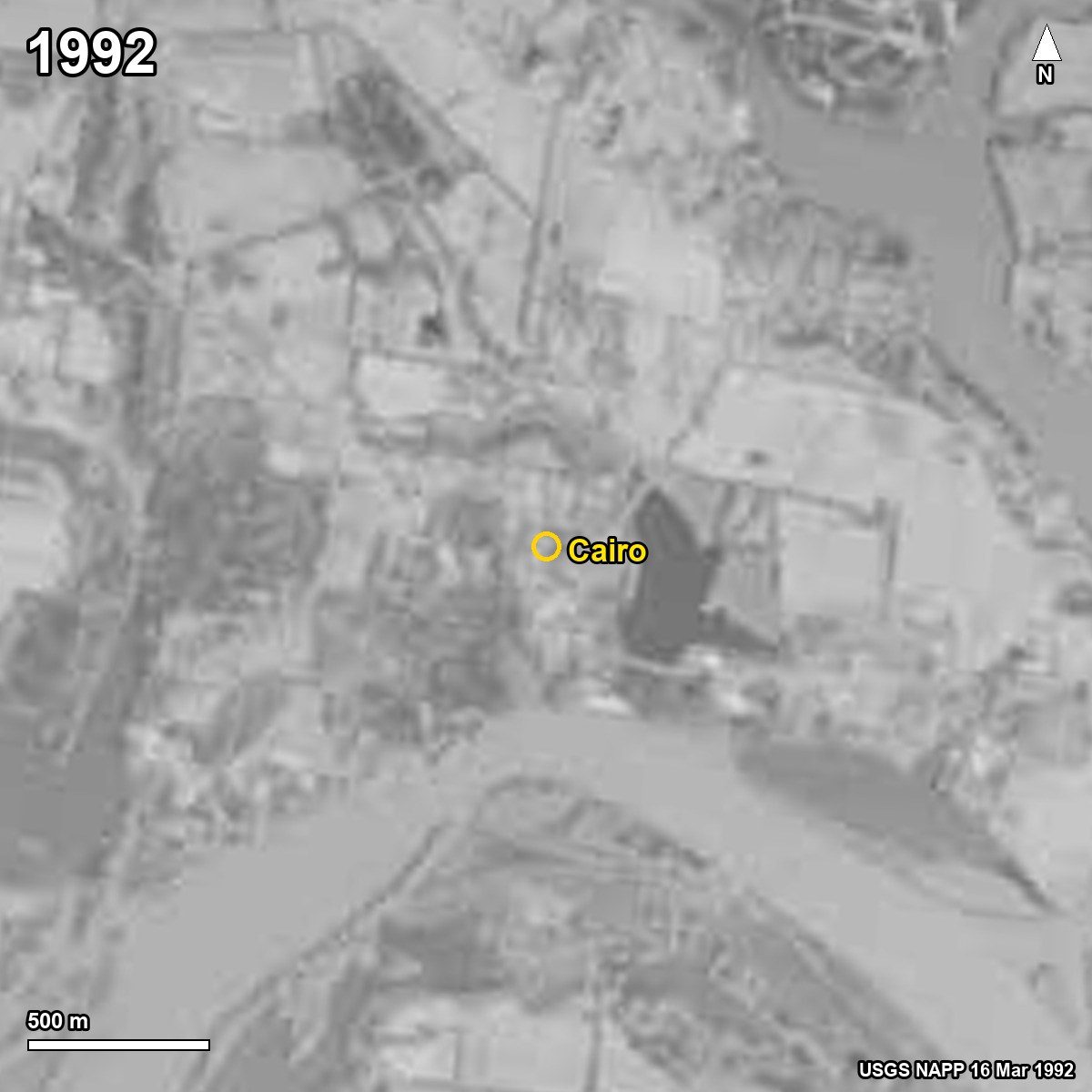
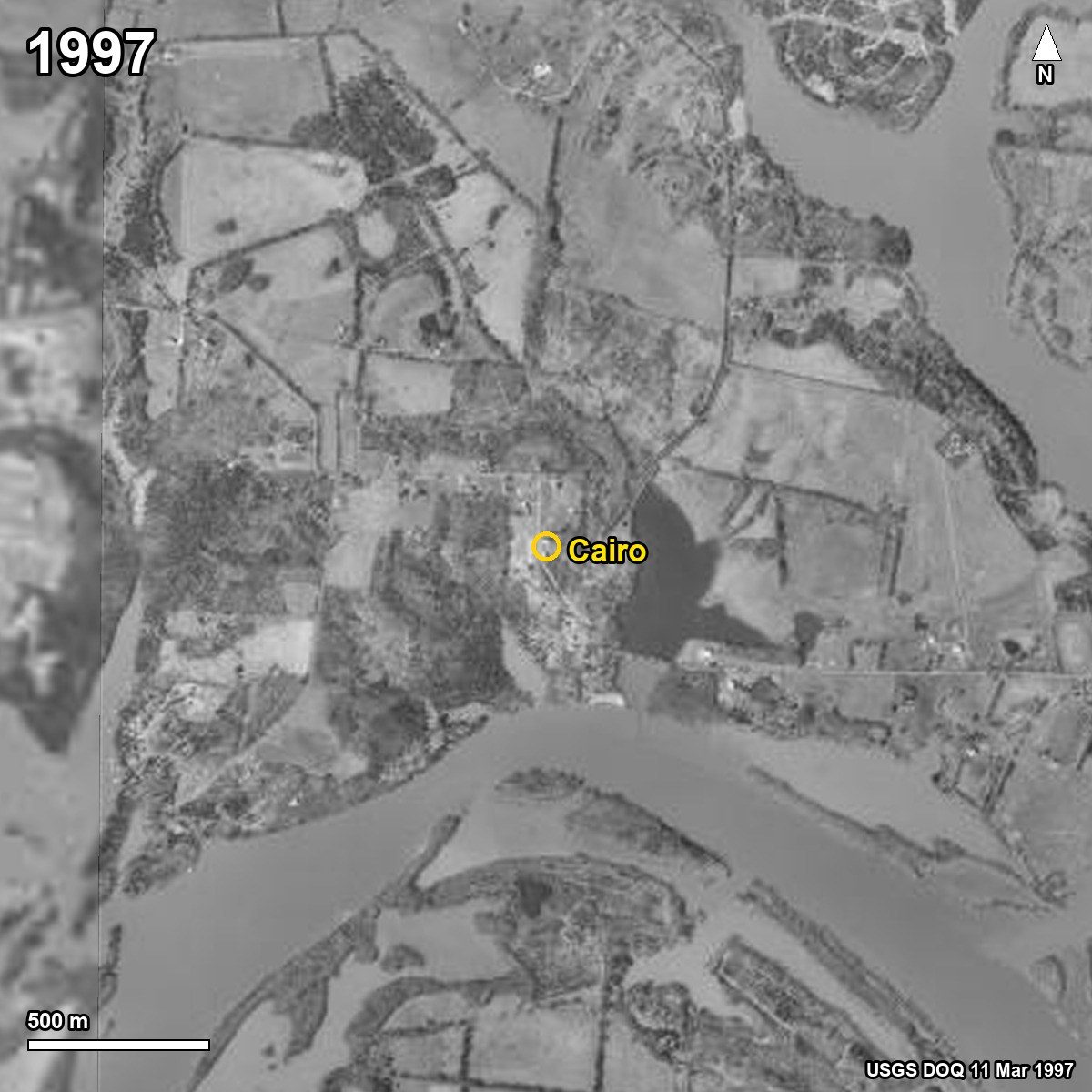
Drag the slider to see the village from the air. The yellow ring is the church. The roads of the old village, laid out in 1799, still meet below it.
The wider view shows the Cumberland River in its old banks in 1950 and 1953, and then Old Hickory Lake after the dam closed in 1954.
Old maps
Cairo in 1878. "M. E. Ch." (the Methodist Episcopal Church) stands on the west side of the road north of the crossroads, with "Col. Ch." (the Black congregation's church), the store, and the warehouse on the river. D. G. Beers & Co., Map of Sumner County, Tennessee, 1878, Library of Congress.The country around Cairo in 1878: "P. E. Youree" just northeast of the village, more Youree farms to the north and west, and the Barnes, Haynes, Robb and Newton places. D. G. Beers & Co., Map of Sumner County, Tennessee, 1878, Library of Congress.
The 1955 government map: the church (a square with a cross) and "Cem" beside it, the school, a second church to the southeast, and the new lake. The lake is drawn in, though it was not filled until after 1954. U.S. Geological Survey, Hunters Point map, 1955.Cairo and Gallatin in 1942, with the Cumberland River still in its old channel, twelve years before the dam. U.S. Geological Survey, Gallatin map, 1942.
The 1950 census map of Civil District 2, with "Cairo" on the river bend and church crosses at the village. 1950 U.S. census map, Sumner County, National Archives.The 1996 county tax map: "Cairo Meth. Church" beside the Rosenwald School lot, with Williams Chapel Baptist, the C.M.E. church and the Robb cemetery nearby. Sumner County tax map 133, from the 1996 National Register file for the Cairo Rosenwald School.
The 1955 map shows a "Cem" (cemetery) just northeast of the church. That graveyard belongs to a family, not the church. Many old Cairo families buried their dead in their own graveyards close by: the Barnes, Preuett, Robb, Newton, Wilks, Austin and Donoho cemeteries all lie within about a third of a mile.
The family who built it
Henry H. Youree, the parents he honored, and the brother who stayed at Cairo. Tap a card to open it.
1Henry Hudson YoureeAugust 2, 1856 - May 12, 1910; married Mary Rose AustinProven by records
The youngest child of Patrick and Malvina Youree, born in Missouri. During the Civil War the family moved to its farm at Cairo, and Henry grew up and went to school there. He took a business course in St. Louis, went to Texas at nineteen to work for his brother Peter, built railroads and streetcar lines with W. T. Scott Jr., and from 1898 was vice president of the Commercial National Bank of Shreveport. He and Mary Rose had no children, but he was always "caring for or aiding some helpless child."
He left $5,000 for a church or school at Cairo in memory of his parents. It became the church.
Henry Hudson Youree's monument at Scottsville, Texas: "Aug. 2, 1856 - May 12, 1910." Find a Grave (memorial 5565004).Henry H. Youree's will, April 23, 1910. Item Fifth: "my Executors have erected at or near Cairo, Sumner County, Tennessee either a Church or School House ... in memory of my father and mother and to cost not less than Five Thousand Dollars." Will of H. H. Youree, Caddo Parish, Louisiana, as recorded in Sumner County, Tennessee; FamilySearch.May 26, 1910: "$5,000 in the erection of a school, or church ... at Cairo, Tenn., in memory of the father and mother of deceased." The Shreveport Journal, May 26, 1910, p. 2, via Newspapers.com.The New Orleans paper reports the same will: "an equal sum be used for placing a memorial, either school or church, at Cairo, Tenn., in memory of his parents." The Times-Picayune, New Orleans, May 27, 1910, p. 14, via Newspapers.com."In Memoriam," Henry H. Youree, from the Shreveport home for the homeless he also remembered in his will. The Shreveport Times, May 29, 1910, p. 24, via Newspapers.com."During the war when the Federals had overrun Missouri, his father, P. E. Youree, his mother, Malvina M. Youree, and the younger children went to a quiet little home they had inherited, situated on the Cumberland River, just between Nashville and Gallatin. There Henry received his early training and education." The Shreveport Times, May 29, 1910, p. 24, via Newspapers.com.May 14, 1910: a special train of three coaches took Henry Youree's family and friends to Scottsville, Texas, for his burial. The Shreveport Journal, May 14, 1910, p. 4, via Newspapers.com.
Sources: His will (Caddo Parish, 1910, recorded in Sumner County); 1870 census; Shreveport Journal, May 14 and 26, 1910; Shreveport Times, May 29, 1910; Times-Picayune, May 27, 1910; Sumner County News, October 12, 1916; gravestone, Scottsville, Texas.
2Patrick Espy Youree and Malvina Margurite ZimmermanPatrick: February 16, 1812 - April 19, 1885. Malvina: February 12, 1817 - May 28, 1883. Married 1833Proven by records
The parents the church honors. Patrick was born in Tennessee, Malvina in Kentucky. They married in 1833 and farmed in Lafayette County, Missouri, where most of their eight known children were born: Francis, Margaret, Alexander, Peter, Charles, Patrick, Isaac and Henry. In the Civil War they came back to Tennessee, to an inherited farm on the Cumberland at Cairo. The 1878 county map shows their place just northeast of the village. They are buried together in the Gallatin City Cemetery.
The Youree monument in the Gallatin City Cemetery: "Patrick Espy Youree, born Feb. 16, 1812, died April 19, 1885. Malvina Marguerite Youree, born Feb. 12, 1817, died May 28, 1883." Photo by BBrown, 2014, Find a Grave (memorial 99038586).The 1870 census in Sumner County: Patrick Youree, 58, farmer; Malvina, 54; sons Patrick, 22, Isaac, 20, and Henry, 13, "at school." 1870 U.S. census, Sumner County, Tennessee, FamilySearch.The 1880 census in the Second District (Cairo): Patrick, 68, farming; Malvina, 64; and their son Pat, 32. 1880 U.S. census, Sumner County, Tennessee, FamilySearch.The country around Cairo in 1878: "P. E. Youree" just northeast of the village, more Youree farms to the north and west, and the Barnes, Haynes, Robb and Newton places. D. G. Beers & Co., Map of Sumner County, Tennessee, 1878, Library of Congress.
Sources: Censuses of 1850 (Missouri), 1870 and 1880 (Sumner County); 1878 county map; their son's 1910 memorial and 1923 death record; gravestone, Gallatin City Cemetery.
3Patrick Espy Youree Jr.December 17, 1847 - February 15, 1923Proven by records
Born in Missouri. The son who stayed on the Cairo farm. He never married and lived 29 years with the Prewett family at Cairo; his obituary says he "owned a nice farm and was quite wealthy." Henry's will let Patrick keep farming Henry's part of the family land for as long as he lived. In 1916 Patrick chose a church over a school for Henry's gift, directed its building and served as a trustee. His funeral was preached there in 1923.
Another face of the same monument: "Patrick Espy Youree Jr., born Dec. 17, 1847, died Feb. 15, 1923." Photo by BBrown, 2014, Find a Grave (memorial 99038638).February 1923: Patrick E. Youree Jr. dies at Cairo. "One of his brothers, Henry, left a sum of money to build a church at Cairo, and the funeral will be preached in this church." Nashville Banner, February 16, 1923, p. 2, via Newspapers.com.Patrick Espy Youree Jr.'s death record, Cairo, February 15, 1923: born in Missouri in December 1847; father Patrick Youree, born in Tennessee; mother a Zimmerman, born in Kentucky. Tennessee death records, Sumner County, 1923, FamilySearch.January 5, 1923: trustees T. W. Barnes, C. B. Pruett, W. G. Schamberger, P. E. Youree and C. H. Newton receive $7,277.93 left to the church by Miss Sallie E. Bruce. Sumner County court records, January 1923, FamilySearch.
Sources: Death record, Sumner County, 1923; Nashville Banner, February 16, 1923; Sumner County News, October 12, 1916; county court records, 1923; gravestone.
4Capt. Peter S. YoureeApril 23, 1843 - July 31, 1914; married Mary Elizabeth "Bettie" Scott in 1870Proven by records
Born in Lafayette County, Missouri. A captain in Shelby's Missouri cavalry in the Civil War. He set up as a merchant at Scottsville, Texas, married into the Scott family there, and became president of the Commercial National Bank of Shreveport. His obituary says he gave the Confederate monument in Shreveport's Greenwood Cemetery and a memorial church at Scottsville for his son. He was Henry's partner and one of the two people Henry chose to carry out his will, but he died two years before the Cairo church was built.
Capt. Peter Youree (1843-1914), Henry's older brother, a banker, who helped carry out Henry's will. Portrait as printed in an early 1900s publication, via Find a Grave (memorial 5564998).Peter Youree's gravestone at Scottsville, Texas. It calls him a captain in General Shelby's Missouri cavalry, on the Confederate side. Find a Grave (memorial 5564998).
Sources: 1850 census; Shreveport papers, 1910; his obituary (Confederate Veteran, November 1914); gravestone, Scottsville, Texas.
5Francis YourieMarch 17, 1775 - March 30, 1861Likely
Very likely Patrick's father. The 1880 census says Patrick's father was born in Ireland, and Patrick's middle name, Espy, matches Francis's wife, Margaret "Peggy" Espy. Francis lived in Sumner County from at least 1830 and is buried in the Gallatin City Cemetery. He died in March 1861, just before the war, which fits the family story that Patrick and Malvina came to "a quiet little home they had inherited" on the Cumberland.
Sources: 1830 and 1860 Sumner County censuses; 1880 census; Gallatin City Cemetery memorials. His tie to Patrick is not yet proven by a record that names them as father and son.
The families who kept it
The trustees, givers and members who carried the church through the 1900s.
From 1916 into the 1950s a few farm families ran the Cairo church, and they married into each other. The Barnes family had the old homestead and the store. The Preuetts (the name is also spelled Pruett, Pruitt and Prewett in old papers; it is one family) had their own graveyard. John M. Johnson kept the grocery, and the Bradleys married into both the Barnes and the Preuett families. The same families ran everything: they kept the church, planned Children's Day, carried each other's coffins, and led the community club. Unmarried women held much of it together: Dovie and Martha Barnes, Belle Preuett and Thankful Johnson.
6Miss Sallie E. Brucedied about 1920Proven by records
She left half of what remained of her estate to "the Methodist Episcopal church at my old home, Cairo," to be lent out, with the interest going to the pastor's pay. The church received $7,277.93 in January 1923. The other half went to the Presbyterian church in Gallatin.
January 5, 1923: trustees T. W. Barnes, C. B. Pruett, W. G. Schamberger, P. E. Youree and C. H. Newton receive $7,277.93 left to the church by Miss Sallie E. Bruce. Sumner County court records, January 1923, FamilySearch.
Sources: Her will (Sumner County, will book 7, p. 178) as quoted in the county court records of 1923 and 1924.
7Thomas W. BarnesNovember 14, 1859 - January 1, 1933Proven by records
Born at "the old Barnes homestead near Cairo," the son of Samuel K. Barnes. The old brick store and saloon at 2501 Cairo Road still carries the Barnes name. A trustee of the church in 1916 and 1923. In 1907 he signed for St. Mathews Chapel's building loan. His second marriage, to Emma Crutcher in 1917, was performed by the Cairo pastor, and his own funeral was held in the church.
Sources: His obituary (January 1933); Sumner County News, 1916 and 1917; county court and deed records of 1907, 1919 and 1923; 1860 census.
8C. B. "Boud" PreuettNovember 6, 1872 - July 25, 1948Proven by records
A son of Paul P. and Louisa Preuett, whose family graveyard is at Cairo, and a trustee of the church in 1916 and 1923. Patrick Youree Jr. lived with the Preuett family for 29 years, and a brother, P. Y. Preuett, may have been named for him. Boud's sister Belle paid her dues to the church until she died in 1961.
Sources: His obituary (1948); Sumner County News, 1916; county court records, 1923 and 1958-61; Preuett Cemetery stones.
9Tom Bradley and Homer BradleyTom: born about 1903. Homer: June 30, 1928 - 2022Proven by records
Tom Bradley, a grandson of T. W. Barnes, married Ethel Preuett, Boud Preuett's daughter, and was a church trustee in 1953. Their son Homer was a member of the Cairo church for more than 90 years and was known as Cairo's "unofficial mayor." The Methodist churches of Tennessee gave him their Allison Social Holiness Award, for a lifetime of helping his neighbors.
Sources: 1953 boundary agreement; 1940 census; Gallatin News obituary of Homer Bradley, 2022; Sumner County Museum.
10John M. Johnson and Thankful JohnsonJohn: May 20, 1857 - April 8, 1938. Thankful: November 4, 1901 - May 16, 1988Proven by records
John M. Johnson farmed, built two of the old houses on Cairo Road, and ran the grocery store at Cairo for seventeen years. "Funeral services were conducted from the Cairo Methodist Church of which he was a member." His daughter Thankful was secretary of the Cairo Community Improvement Club, which met in the church.
Sources: His obituary (1938); state survey of old buildings, 1982 and 1994; Gallatin newspapers, 1953 and 1958.
11Miss Dovie Barnesborn about 1905Proven by records
A daughter of J. H. Barnes, she lived with her sister Martha in the old J. H. Williams house at Cairo. She served on the church's Children's Day committee in 1945 and collected dues for the church in the 1950s. She was also Cairo's historian: she wrote a "History of Cairo" for the Gallatin paper in 1956 and, with others, "A Brief History of Cairo Community" (1964).
Dovie Barnes's 1956 "History of Cairo": "This church has a seating capacity of one hundred and fifty and two Sunday school rooms." Dovie Barnes, Gallatin newspaper, spring 1956, FamilySearch.
Sources: Gallatin newspapers, 1945 and 1956; county court records, 1958-61; state survey of old buildings, 1982.
St. Mathews Chapel and the Rosenwald School
The Black congregations and school that grew up beside the church.
Cairo's Black families built their own churches and school within a few hundred yards of the Methodist church. The 1878 map already marks a "Col. Ch." In 1881 the trustees of the Colored Methodist Episcopal Church at Cairo took title to a lot in town. By 1907 the members of St. Mathews Chapel needed a new building. They bought the lumber, borrowed for shingles, flooring and carpenters, and rebuilt. In 1909 the district conference of their church met at Cairo. Williams Chapel Baptist Church went up nearby in 1908. People at Cairo remembered Jeff Scott as the first pastor of both.
July 1907: Howard Mills, Gaston Harrison (the name is hard to read) and Wm Robb, trustees of "St. Mathews Chapel Colored Methodist Episcopal Church in America, situated at Cairo," pledge the church lot for a building loan. C. H. Newton and T. W. Barnes signed for the loan with them. Sumner County deed records, 1907, p. 263, FamilySearch.
12The trustees of St. Mathews Chapel1881 and 1907Proven by records
Thomas Davis and others held the lot as trustees in 1881. In 1907 the trustees were Howard Mills, Gaston Harrison and Wm Robb. The members had "determined to tear down the old house of worship as the same is unsafe and to build a new one."
July 1907: Howard Mills, Gaston Harrison (the name is hard to read) and Wm Robb, trustees of "St. Mathews Chapel Colored Methodist Episcopal Church in America, situated at Cairo," pledge the church lot for a building loan. C. H. Newton and T. W. Barnes signed for the loan with them. Sumner County deed records, 1907, p. 263, FamilySearch.
Sources: Sumner County deed records, 1907 (citing the 1881 deed); 1910 census; state survey of old buildings, 1983 and 1994.
13Jack and Cornelia Wilkesborn about 1865 and 1866Proven by records
They built the log house of about 1915 at 2320 Cairo Road. Their son Andrew bought a lot in 1919 "bounded on the North [by] Church lot," and their daughter Mary E. and her husband Leslie Hamilton owned the land next to the Methodist church in 1953.
Sources: 1920 and 1930 censuses; county deed records, 1919 and 1953; state survey of old buildings, 1983 and 1994.
14Charles Jackson Robbborn about 1896Proven by records
He ran Robb's Grocery with his farm, across the road from the school; until a well was dug in 1951 the schoolchildren carried their water from his house. His grandfather Jim Williams built the log house he lived in. He remembered the history of St. Mathews Chapel and Williams Chapel and passed it on.
Sources: 1900 and 1950 censuses; National Register file for the Cairo Rosenwald School, 1996; state survey of old buildings, 1982-83.
The Rosenwald School
The Cairo Rosenwald School was finished in 1923. It was built on the standard Rosenwald plan for a one-teacher school, with money from Cairo's Black families ($700), the state ($700) and the Rosenwald Fund ($500). It had electric lights in the 1940s and running water from a 365-foot well in 1951. It closed in May 1959, when the county shut its small schools and sent the children to bigger ones, and it has served ever since as the community's meeting place. The Cairo Improvement Club, led by Velma Brinkley and the school's last principal, J. Hutch Brinkley, had it put on the National Register of Historic Places in 1996.
The Cairo Rosenwald School, built 1922-23, next to the church lot. Photo by "rossograph," 2021, Wikimedia Commons, CC BY-SA 4.0.The school in April 1996, when it was put on the National Register of Historic Places. Photo by Elizabeth A. Straw, 1996, National Register of Historic Places file, National Park Service.The state historical marker for the Cairo Rosenwald School. Photo by Brian Stansberry, 2008, Wikimedia Commons, CC BY 3.0.
Before 1865
Before the Civil War the farm families around Cairo held people in slavery. In 1860 eighty people were enslaved by fourteen households around Cairo, among them Mary A. Youree (the widow of Henry's uncle Alexander), who held five people, W. N. Robb, nine, and S. K. Barnes, one. The census wrote down only their ages, never their names. In 1870 four Black Tennesseans lived in Patrick Youree's household at Cairo: Ann Stratton, a 30-year-old servant, and three children.
The 1860 census list of enslaved people for the district around Cairo. It gives only ages and sex, never names. 1860 U.S. census, Sumner County, Tennessee, slave schedule, District 4, p. 22, FamilySearch.
The records
Every record and photo behind this story. Tap any one to see it large.
Henry H. Youree's will, April 23, 1910. Item Fifth: "my Executors have erected at or near Cairo, Sumner County, Tennessee either a Church or School House ... in memory of my father and mother and to cost not less than Five Thousand Dollars." Will of H. H. Youree, Caddo Parish, Louisiana, as recorded in Sumner County, Tennessee; FamilySearch.May 26, 1910: "$5,000 in the erection of a school, or church ... at Cairo, Tenn., in memory of the father and mother of deceased." The Shreveport Journal, May 26, 1910, p. 2, via Newspapers.com.The New Orleans paper reports the same will: "an equal sum be used for placing a memorial, either school or church, at Cairo, Tenn., in memory of his parents." The Times-Picayune, New Orleans, May 27, 1910, p. 14, via Newspapers.com."In Memoriam," Henry H. Youree, from the Shreveport home for the homeless he also remembered in his will. The Shreveport Times, May 29, 1910, p. 24, via Newspapers.com."During the war when the Federals had overrun Missouri, his father, P. E. Youree, his mother, Malvina M. Youree, and the younger children went to a quiet little home they had inherited, situated on the Cumberland River, just between Nashville and Gallatin. There Henry received his early training and education." The Shreveport Times, May 29, 1910, p. 24, via Newspapers.com.May 14, 1910: a special train of three coaches took Henry Youree's family and friends to Scottsville, Texas, for his burial. The Shreveport Journal, May 14, 1910, p. 4, via Newspapers.com.October 12, 1916: "Large Crowd Gathers Cairo Sunday For All-Day Service" for the dedication of the new church. Sumner County News, Gallatin, October 12, 1916, p. 1, FamilySearch."The church, which is a handsome brick structure, was built by a bequest of the late Mr. Henry H. Youree of Shreveport, Louisiana ... Mr. P. E. Youree of Cairo, a brother of the deceased, decided that the fund should be used in the erection of a church and has directed its construction." Sumner County News, Gallatin, October 12, 1916, FamilySearch.January 5, 1923: trustees T. W. Barnes, C. B. Pruett, W. G. Schamberger, P. E. Youree and C. H. Newton receive $7,277.93 left to the church by Miss Sallie E. Bruce. Sumner County court records, January 1923, FamilySearch.February 1923: Patrick E. Youree Jr. dies at Cairo. "One of his brothers, Henry, left a sum of money to build a church at Cairo, and the funeral will be preached in this church." Nashville Banner, February 16, 1923, p. 2, via Newspapers.com.Patrick Espy Youree Jr.'s death record, Cairo, February 15, 1923: born in Missouri in December 1847; father Patrick Youree, born in Tennessee; mother a Zimmerman, born in Kentucky. Tennessee death records, Sumner County, 1923, FamilySearch.The 1870 census in Sumner County: Patrick Youree, 58, farmer; Malvina, 54; sons Patrick, 22, Isaac, 20, and Henry, 13, "at school." 1870 U.S. census, Sumner County, Tennessee, FamilySearch.The 1880 census in the Second District (Cairo): Patrick, 68, farming; Malvina, 64; and their son Pat, 32. 1880 U.S. census, Sumner County, Tennessee, FamilySearch.July 1907: Howard Mills, Gaston Harrison (the name is hard to read) and Wm Robb, trustees of "St. Mathews Chapel Colored Methodist Episcopal Church in America, situated at Cairo," pledge the church lot for a building loan. C. H. Newton and T. W. Barnes signed for the loan with them. Sumner County deed records, 1907, p. 263, FamilySearch.April 16, 1953: trustees Tom Bradley, Roy Brown and Earl Fitzpatrick of "the Methodist Church of Cairo" settle the line of the church lot with the neighbors. Sumner County deed records, 1953, FamilySearch.The 1860 census list of enslaved people for the district around Cairo. It gives only ages and sex, never names. 1860 U.S. census, Sumner County, Tennessee, slave schedule, District 4, p. 22, FamilySearch.A 1929 history of the Cairo church: "In the halcyon days of Cairo the Methodist congregation was composed of the Youree, Blakemore, Conn, Patterson, Newton, Hamilton, Bruce, Green and other families." Mrs. Bennett D. Bell, Sumner County News, Gallatin, 1929, FamilySearch.Dovie Barnes's 1956 "History of Cairo": "This church has a seating capacity of one hundred and fifty and two Sunday school rooms." Dovie Barnes, Gallatin newspaper, spring 1956, FamilySearch."Tribute to parents remains": the 1987 newspaper photo and its caption, which quotes the stone over the front door. The Tennessean, March 4, 1987, p. 40, via Newspapers.com."A humble Tennessee town that had great beginnings," 1991: "The Methodist Church dates to 1806 and still meets regularly in a house of worship completed in 1916." M. J. Caldwell, The Tennessean, February 6, 1991, p. 51, via Newspapers.com.Cairo in 1878. "M. E. Ch." (the Methodist Episcopal Church) stands on the west side of the road north of the crossroads, with "Col. Ch." (the Black congregation's church), the store, and the warehouse on the river. D. G. Beers & Co., Map of Sumner County, Tennessee, 1878, Library of Congress.The country around Cairo in 1878: "P. E. Youree" just northeast of the village, more Youree farms to the north and west, and the Barnes, Haynes, Robb and Newton places. D. G. Beers & Co., Map of Sumner County, Tennessee, 1878, Library of Congress.Cairo and Gallatin in 1942, with the Cumberland River still in its old channel, twelve years before the dam. U.S. Geological Survey, Gallatin map, 1942.The 1955 government map: the church (a square with a cross) and "Cem" beside it, the school, a second church to the southeast, and the new lake. The lake is drawn in, though it was not filled until after 1954. U.S. Geological Survey, Hunters Point map, 1955.The 1950 census map of Civil District 2, with "Cairo" on the river bend and church crosses at the village. 1950 U.S. census map, Sumner County, National Archives.The 1996 county tax map: "Cairo Meth. Church" beside the Rosenwald School lot, with Williams Chapel Baptist, the C.M.E. church and the Robb cemetery nearby. Sumner County tax map 133, from the 1996 National Register file for the Cairo Rosenwald School.The church lot today (3.6 acres), with the county's lot lines. Tennessee property maps over Tennessee Department of Transportation imagery.The Youree monument in the Gallatin City Cemetery: "Patrick Espy Youree, born Feb. 16, 1812, died April 19, 1885. Malvina Marguerite Youree, born Feb. 12, 1817, died May 28, 1883." Photo by BBrown, 2014, Find a Grave (memorial 99038586).Another face of the same monument: "Patrick Espy Youree Jr., born Dec. 17, 1847, died Feb. 15, 1923." Photo by BBrown, 2014, Find a Grave (memorial 99038638).Henry Hudson Youree's monument at Scottsville, Texas: "Aug. 2, 1856 - May 12, 1910." Find a Grave (memorial 5565004).Peter Youree's gravestone at Scottsville, Texas. It calls him a captain in General Shelby's Missouri cavalry, on the Confederate side. Find a Grave (memorial 5564998).Capt. Peter Youree (1843-1914), Henry's older brother, a banker, who helped carry out Henry's will. Portrait as printed in an early 1900s publication, via Find a Grave (memorial 5564998).
What's still unknown
The stone over the front door. Does it really say "Patrick E. Jr."? A clear photo would answer it. If you have old photos, papers or memories of the Cairo church, they could fill in any of these.
The first church building. When the first Methodist meeting house went up at Cairo, and whether it stood on today's lot, isn't recorded. The 1964 booklet "A Brief History of Cairo Community" by Dovie Barnes and others may say; a copy is at the Tennessee State Library and Archives in Nashville.
Who gave the land. No deed giving the lot to the church has been seen. The Sumner County Register of Deeds in Gallatin holds the deed books from 1793 on.
Pastors from 1923 to 1988. The Tennessee Conference's yearly journals list every pastor and member count. Copies are at the conference archives and at Vanderbilt's Divinity Library in Nashville.
The church's own records. Member rolls, minutes and the 1916 building accounts, if they survive, would be with the congregation or the Cumberland River District office.
Rev. Jeff Scott. Remembered as the first pastor of the C.M.E. church and Williams Chapel. A Jeff Scott of the county's 4th district, with his wife Mattie and twelve children, may be him, but no record yet calls that man "Rev."
Malvina Zimmerman's parents. She was born in Kentucky in 1817 and married in Pope County, Illinois, in 1833. Her parents' names aren't known.
Henry Youree's estate papers. The Caddo Parish court file in Shreveport would show the $5,000 being paid out for Cairo.